

What are the best Runlayer and MintMCP alternatives for employee AI access?
Two hundred people already use ChatGPT and Claude. Four systems hold the actual work: Salesforce, Jira, Notion, NetSuite. Runlayer and MintMCP alternatives are decided by architecture, not by a feature grid. Choose the shape first. The vendor shortlist falls out of the shape.
First the jargon. MCP (Model Context Protocol) is the standard way an AI assistant calls tools in other apps An endpoint is the URL an AI client is pointed at. A grant is the record saying a named person may use a named resource.
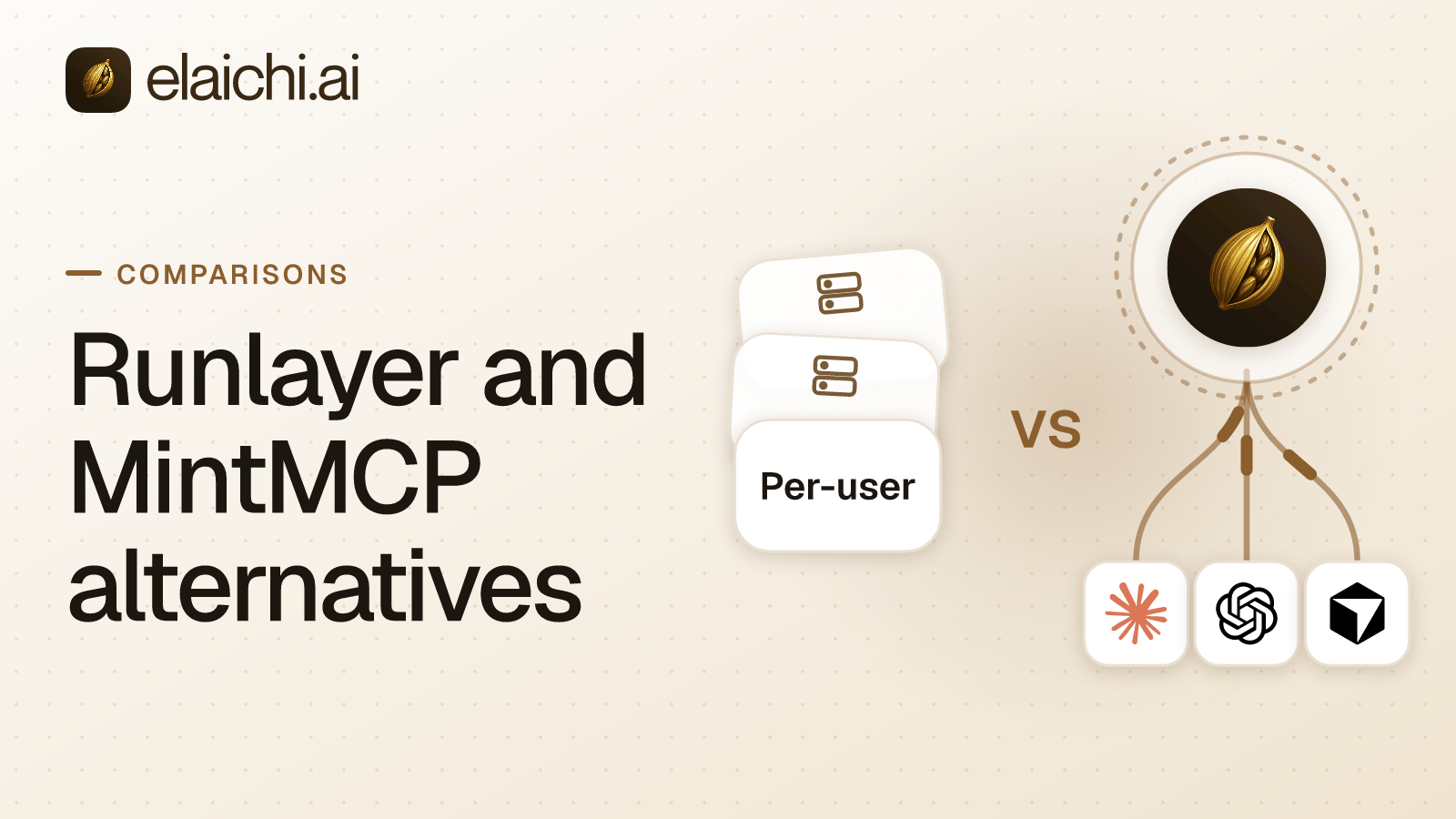
Four shapes are on the market:
- A hosted gateway over MCP servers the vendor hosts or catalogs for you.
- A gateway you run in front of MCP servers you run.
- A per-member server created inside an automation account.
- A governed MCP control plane with native connectors behind one organization-wide endpoint. Elaichi is this one.
Each shape settles three things for you: where the address lives, what the credential is, and who owns a connector when a third party changes its API.
Where does the address live, and what authorizes the call?
| Architecture | Address model | Audit tenancy | Offboarding shape | Connector authoring |
|---|---|---|---|---|
| Runlayer (hosted gateway over vendor catalog) | Vendor's endpoint | Vendor tenant | Revoke through the vendor console | Vendor's catalog, breadth on day one |
| MintMCP (proxy over servers you run) | Self-hosted proxy URL | Your infrastructure and your logs | Revoke at your proxy | Your engineers author the servers; the proxy federates them |
| Per-user servers (Zapier-style) | One URL and token per member | The automation account's tenant | Delete each member's server and token | The automation product's action library, often the widest coverage |
| Governed control plane with native connectors (Elaichi) | One org-wide endpoint behind OAuth | Per-org log tenant, enforced in the type system | Grant revoked in the same transaction as the membership change, effective on the next call | Elaichi authors, maintains and serves; a missing app is a fork or a JSON-config connector, not a proxy |
Either the URL is the secret, or the URL is public and the grant behind OAuth is the secret. OAuth here means the person signs in through a browser, and the client never holds a password or a long-lived token.
Elaichi serves every connected account through one organization-wide endpoint: POST /mcp, standard MCP over Streamable HTTP, JSON-RPC 2.0, stateless, behind OAuth. There are no per-toolbox URLs and no embedded tokens. A toolbox is a saved set of tools and accounts, and it does not get an address of its own. Claude, ChatGPT and Cursor are each pointed at that single address through their own admin console. What varies per person is the grant, not the URL.
That choice changes offboarding. removing or suspending a member revokes every live grant in the same transaction as the membership change, and the revocation flag is re-read on every single call. A role change or a restriction change behaves differently. It takes about two minutes to take effect, and a rollout plan should say so.
Zapier documents the other end of the range. For most MCP clients the member signs in inside the client, and Zapier creates the server during that sign-in. Clients not on Zapier's list, and code you write, use a connection token instead. It is long-lived, tied to one server, and "grants whoever holds it the ability to run the server's tools" (Zapier docs, checked September 2026). Zapier's guidance is to give each user their own server and token. That per-member address model gets its own treatment in the Zapier MCP write-up.
Composio's MCP Gateway page says each team gets its own MCP endpoint, authenticated with SSO, meaning employees sign in with the company identity provider (composio.dev, checked September 2026). Per-team endpoints are easy to reason about inside one team. One org-wide endpoint is easier to roll out across three clients. Ask each vendor what has to change, in every client, when one person moves team.
Who authors the connectors, and who fixes one when it breaks?
There are three answers, and they carry different bills.
MintMCP describes a hosted MCP gateway that "hosts our MCPs and manages credentials", with hosted connectors and a large server catalog (mintmcp.com, checked September 2026). Lunar.dev describes MCPX as a self-hosted enterprise MCP gateway that sits between agents and the MCP servers, APIs and LLM providers they use, with an open-source version on GitHub (lunar.dev, checked September 2026). Tyk, Zuplo and Kong arrive from API management. Tyk's MCP Gateway proxies remote MCP servers and can generate an MCP proxy from a managed REST API. Zuplo federates MCP servers behind one OAuth-protected gateway. Kong exposes APIs as MCP tools (Tyk, Zuplo, Kong, all checked September 2026).
Elaichi authors, maintains and serves its connectors from its own infrastructure, 450+ of them. Your company does not run MCP servers, and Elaichi does not resell a registry of servers other people operate.
The trade-off is real. A native catalog is a bet on one vendor's roadmap, and if the app you need is missing you fork a connector or author one from JSON config. A registry of third-party servers gives you breadth on the day you sign. A proxy you run gives you anything your engineers can write, plus the pager that comes with it. The real cost of running the servers yourself works through that math.
Where do the credentials for connected accounts sit?
Not in Elaichi. A separate credential service holds per-account secrets, encrypted with AES-256-GCM at rest, and it owns token refresh. A refresh that fails marks the connection needs_reauth instead of failing quietly in the background.
Two details matter when a security reviewer reads the design. A connect URL is a one-time session that carries no token, which is why it is safe to return over MCP. Reading back an account's configuration returns public values plus the list of dot-paths that were encrypted, and none of their values. Editing one of those paths is refused, and the refusal text is identical whichever side produced it. An organization can also supply its own OAuth app per connector, and that is gated on connector management rather than connection management. So everyone who can delete a connection does not silently gain the ability to repoint the org's OAuth app.
What can be stated about Runlayer, and what has to be asked
Nothing in this post characterizes Runlayer. The competitor notes behind it were last checked September 2026 and contain no reading of Runlayer's own documentation. A comparison written from somebody else's blog post is how a buyer ends up defending a claim in a security review that the vendor never made.
Put these questions to Runlayer, and to every other name on your list:
- Is the endpoint one address for the organization, one per team, or one per member?
- Is any URL or token a bearer credential, and what is its lifetime?
- Who authors the connectors, and what is the fix path when a third party changes an API?
- How long does a permission change take to take effect, measured rather than promised?
- What is in one audit record, and are argument values in it?
- What happens to a leaver's access and their connected accounts on their last day?
- Which region holds the data, and is that a guarantee or a placement preference?
- What is the billing unit: seats, tool calls, or tasks?
The answers differ enough that the shortlist usually halves itself.
What a control plane gives an IT team that a URL does not
Three separate layers, kept apart on purpose. Permissions are roles, and each member holds exactly one role, so every role is a complete persona. Sharing is a grant of view, use or edit on a resource, and a member sees only what they own or what was shared with them, org admins included. Restrictions decide which connectors and which individual tools a target may reach.
Restrictions target a role or a user. There is no organization target, and the default is the absence of any rule, which allows everything. A user-targeted rule replaces that user's role rules instead of layering on top of them. An allow rule that names nothing denies everything, which is the strictest thing you can write and the trap people fall into first.
One detail survives audit review better than most. A block matches the tool name or the pinned operation, while an allow matches the pinned operation only, because a tool's advertised name is a label whoever edits the connector documentation controls. Blocks bind labels, allows bind operations explains the reasoning.
Residency is chosen when the organization is created. The eu and us regions are hard residency, compute and storage inside the jurisdiction. The apac region is a placement hint (best-effort). Only eu and us are hard-residency.
What does one audit record contain?
one entry per tool-call attempt, succeeded or failed, and both name the account actually reached. The recorded connection comes from the execution rather than from the intent, because the first question after an unexpected change is which of two Notion workspaces the agent wrote to.
Whether an AI took the action is a recorded field, not a guess from a user agent. Argument names and counts are logged; argument values never are. Failed calls carry an error code, and the text returned to the caller is never the text written to the trail, because audit records are org-visible and fan out to whatever SIEM the customer configured. The log tenant is per organization, enforced in the type system rather than by a WHERE clause. Forwarding to Datadog is implemented, Splunk HEC and Microsoft Sentinel are accepted but not yet delivering, and the read-only Auditor seat is free, so a compliance reviewer does not consume a license.
Where the other shapes beat a control plane
Sometimes the honest answer is one of the alternatives. If your engineers already operate MCP servers in-house, a gateway in front of them is the right shape, and Elaichi is not that: Elaichi is the server, not a proxy for servers you run. If a managed API platform already carries your traffic, an MCP feature inside it may be cheaper than a new plane. If breadth of third-party servers on day one matters more than who authors them, a hosted registry gateway answers that better.
Pricing shapes the decision too. Elaichi Gold is $15 per user per month, or $120 per user per year. The two plans are Gold and Black, with a 14-day trial The trial runs 14 days with no card, and checkout sets the paid trial to the remaining days rather than granting a fresh 14. Composio publishes a free Hobby tier with 3 team members and Pro at $29 a month, billed on tool calls (composio.dev pricing, checked September 2026), and the Composio comparison goes deeper. Zapier MCP has no separate billing, and each successful tool call consumes two tasks from the plan's allowance, with failed calls consuming none (Zapier docs, checked September 2026). Per-seat, per-call and per-task each reward a different usage pattern. Model your own before you compare list prices.
When none of these is the purchase to make yet
Six people using AI against two apps, with no auditor asking questions, do not need a control plane. Native client connectors and careful admin settings will hold for a while. One team building an agent against one internal database needs a server, not a plane. The case for waiting sets out the signals that say you have waited long enough.
How do you run this shortlist in a week?
Run the same test against each vendor and compare recordings, not decks.
- Pick one team and one system they already use, for example support and Zendesk.
- Connect that system, point Claude or ChatGPT at the vendor's endpoint, and have two people sign in.
- Block one destructive tool for one role, then time how long the block takes to bite.
- Run five real tasks, then read the audit records and check which account each call reached.
- Remove one of the two people and confirm what their client can still do on the next call.
Step five is where architectures separate. Browse the connector catalog for the systems that team runs, see how each function uses governed access, and check plans and seat counting before you scope the pilot.