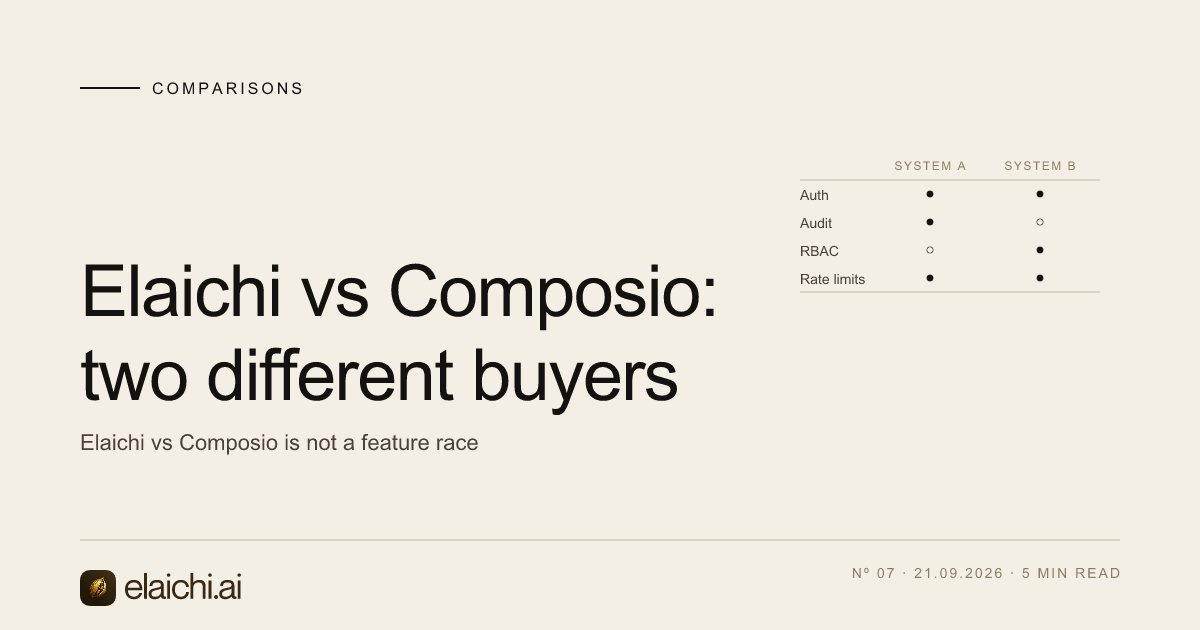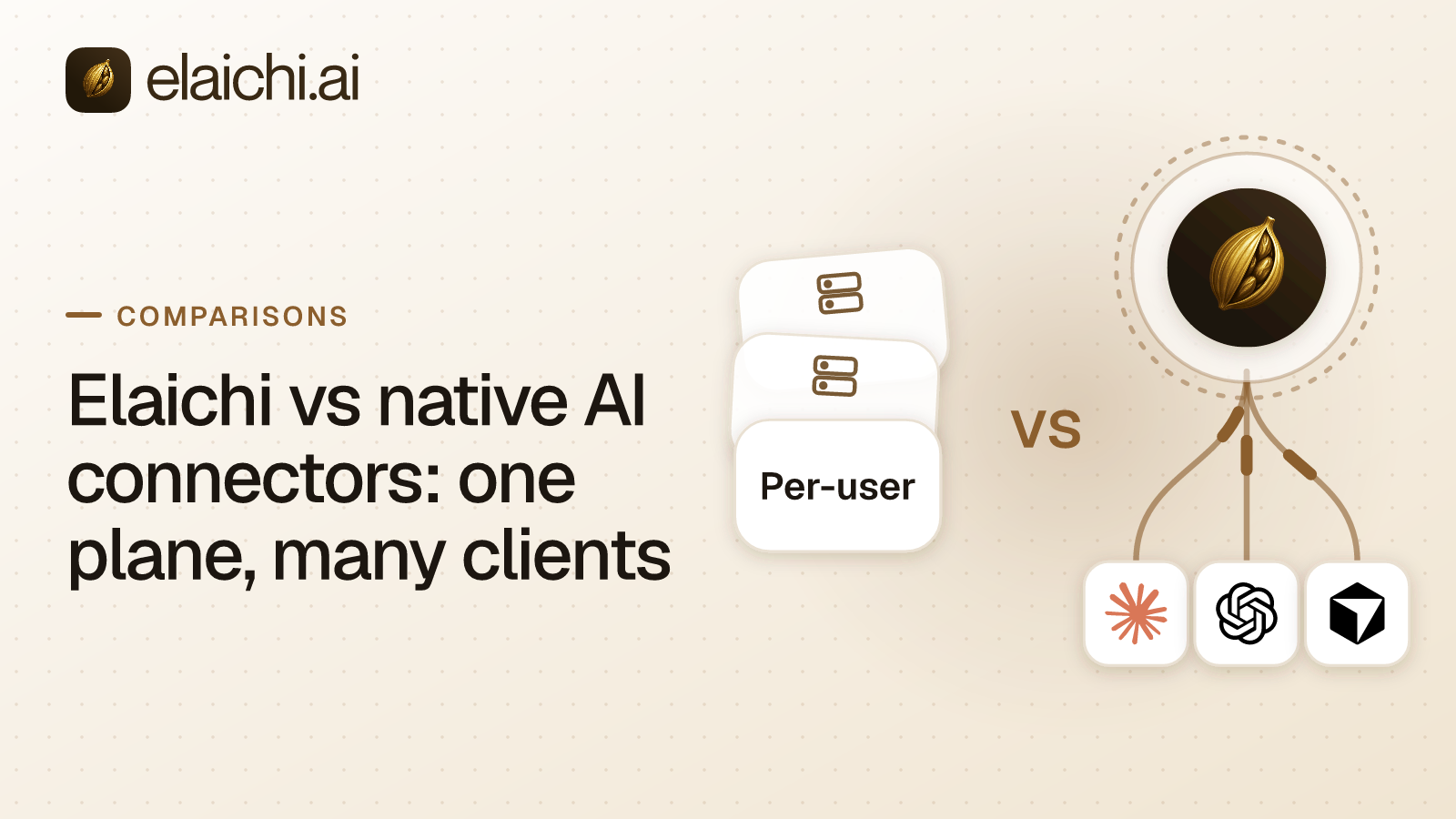


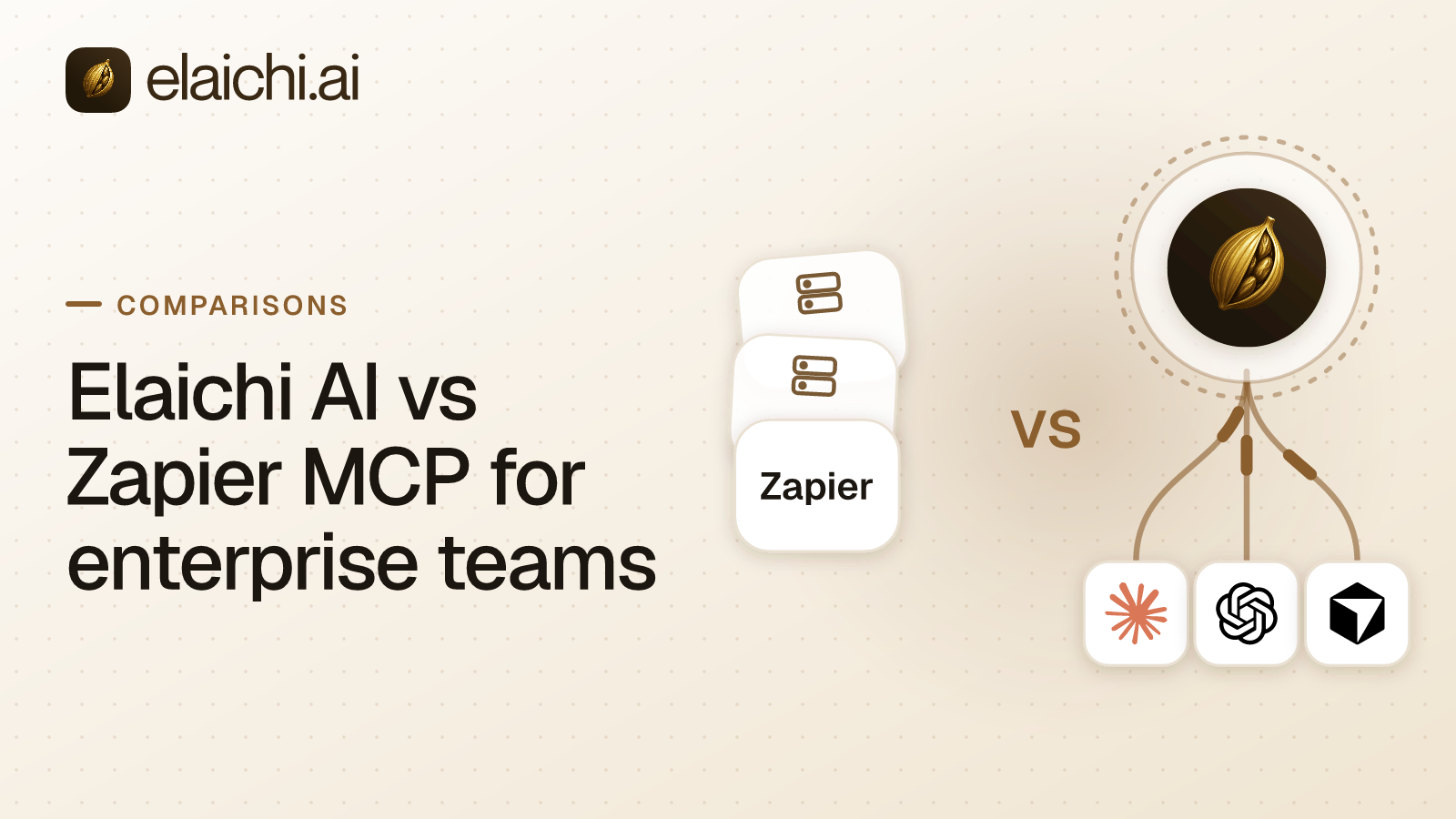
Support is already pasting ticket text into ChatGPT. Finance wants Claude to read the billing system. Somebody in IT has been asked to give two hundred people governed access to company apps this quarter, without handing tokens around. Elaichi AI vs Zapier MCP for enterprise teams is the comparison those teams reach first. It turns on two decisions: where the MCP address lives, and who wrote the connectors behind it. Almost every other difference falls out of those two.
MCP (Model Context Protocol) is the standard way an AI assistant calls tools in other apps
Elaichi AI vs Zapier MCP for enterprise teams: the two shapes
| Axis | Zapier MCP | Elaichi |
|---|---|---|
| Address model | One MCP server per member; docs recommend a server-and-token per user | One org-wide endpoint at POST /mcp behind OAuth |
| Billing at 1,000 calls/user/month | 2,000 tasks per user drawn from your Zapier plan allowance | $15/user/month on Gold, indifferent to call volume |
| Offboarding | Zapier's MCP security page does not state what happens to a member's server | Grant revocation is next-call; preflight refuses removal until personal connections resolve |
| Admin visibility | History tab with user-level activity logs; SAML SSO on Enterprise | Per-org log tenant, actor_kind recorded per call, Datadog export shipped |
| Connector coverage | Same app connections and actions as Zaps, mature and broad | 450+ connectors Elaichi authors and maintains itself |
| Per-tool restrictions | Account-level app and action restrictions | Role- or user-targeted rules; blocks match tool name or operation |
Elaichi serves every connected account through one organization-wide MCP endpoint. Zapier MCP connects an MCP client to a Zapier account and runs on the same app connections and actions as Zaps.
The Elaichi endpoint is POST /mcp, standard MCP over Streamable HTTP, JSON-RPC 2.0, stateless, behind OAuth (an open standard for granting access without sharing a password). Claude, ChatGPT, Cursor and the Elaichi Agent all point at that one address and sign in. Each of those clients can be pointed there through its own admin console. Adding a fourth MCP client is the same shape.
Zapier describes its product as a way to "connect your MCP client to your Zapier account, so your AI can take real actions in the apps you already use" (Zapier help center, checked September 2026). Zapier's rollout guidance is to "give each user their own server and token rather than sharing one", and in an organization rollout "each member still signs in and runs tool calls as themselves" (Zapier MCP rollout, checked September 2026).
One address with many grants, or many servers with one member each. That is the fork.
Who holds the address, and who holds the grant
In Elaichi the address is constant and the grant varies. In a Zapier MCP rollout the unit that varies is the server.
Elaichi has no per-toolbox URLs and no embedded tokens. There is no MCP server to create, list or revoke per person. Each member holds an OAuth grant, and revoked_at is re-read from the organization store on every single call. removing or suspending a member revokes every live grant in the same transaction as the membership change.
Zapier's documentation describes two sign-in paths. For most MCP clients the member adds Zapier as a connector and signs in inside the client, "and Zapier creates and configures the server during that sign-in". Clients not on Zapier's list, and code you write yourself, use a connection token instead. That token is long-lived, tied to one server, and it "grants whoever holds it the ability to run the server's tools". Zapier says to treat it like a password and never distribute one. The connect endpoint URL is not itself a credential (Zapier MCP docs, checked September 2026).
So the inventory differs. With Elaichi you track grants against one endpoint. With Zapier MCP you track servers, and for code-based clients you track tokens too. The one endpoint instead of one per user post works through that shape in more detail.
Connector credentials never sit inside Elaichi. A separate credential service holds per-account secrets, encrypted at rest with AES-256-GCM, and owns refresh. A failed refresh marks the connection needs_reauth rather than failing silently. A connect URL is a one-time session that carries no token, which is why it is safe to return over MCP. An organization can supply its own OAuth app per connector, and can use per-organization envelope encryption with a customer-managed key in AWS KMS.
Where do the connectors come from
Elaichi authors, maintains and serves its connectors from its own infrastructure. That is 450+ connectors in the public catalog, and your company runs no MCP servers to use them.
Teams that need something the catalog does not have can author a custom connector from JSON config, or fork a public one. A forked connector pulls upstream changes through a review surface that separates new tools, safe updates, config diffs, conflicts and upstream removals. Conflicts and destructive removals stay unchecked by default. Multi-step work becomes a synthetic tool: a graph of steps, each calling a connection's tool with templated arguments. Cycles are rejected at save, independent steps run in parallel, and every step passes the same restriction and audit checks as a direct call.
Zapier MCP draws on the same app connections and actions as Zaps (Zapier help center, checked September 2026). If your operations already sit in Zaps, that lineage is real value, and a separate catalog does not give it to you.
What the model sees once dozens of tools are connected
Elaichi collapses connected tools behind two meta-tools past a threshold of 30 tools. The threshold counts catalog operations and connected tools together, so one connected app is normally enough to trip it.
Only the connected half collapses. Control-plane operations stay listed individually, and search_tools never returns one. execute_tool is only a naming indirection. It unwraps to the same name and arguments and falls through the identical gates, with no separate execution path. Tools withheld by a restriction are excluded from the count, because they were handed to nobody.
Ranking is purely lexical over tool name, description and connector label, with a relevance floor. A tool must account for at least half the query's own IDF-weighted mass. The incident behind the floor is instructive. A user with only Notion connected searched list_all_cal_com_schedules and got back list_all_notion_users, because list and all scored and the rest scored nothing. A tool from an app you did not ask about is worse than nothing, because the model calls it. The relevance floor from first principles covers the ranking in full.
How narrow can the permissions get
Elaichi keeps three layers separate: permissions, sharing and restrictions. Mixing them up is the usual way a rollout goes wrong.
Permissions are roughly 38 action strings grouped into roles, with exactly one role per member. Sharing is a grant of view, use or edit on a resource to a user, a team or the whole organization, and a member sees only what they own or what was shared with them. Restrictions decide which connectors and which individual tools a target may reach.
Restriction targets are role or user only. There is no organization target, and the organization default is the absence of any rule, which allows everything. A rule on a user replaces the role rules for that user rather than adding to them Within the winning layer blocks always beat allows, and an allow rule naming nothing denies everything. Enforcement runs at four points against the same resolver: browse, connect, advertise and execute, plus a final check on the fully substituted outbound URL.
A block matches the tool name or the pinned operation. An allow matches the pinned operation only, for the reason set out in why a block binds the label and an allow binds the operation.
Frozen parameters go one level further. Frozen keys are stripped from the advertised schema, so the model never sees them, and frozen values are merged over caller arguments at execution. Passing the key cannot un-freeze it.
Zapier's controls sit at a different grain. Account-level app and action restrictions are enforced through MCP, and admins can restrict members to a Zapier workspace (Zapier MCP rollout, checked September 2026).
What happens the day somebody leaves
In Elaichi, removing or suspending a member revokes every live grant in the same transaction, so the next call fails. Role and restriction changes behave differently. They resolve through a cache plus edge propagation and take effect within about two minutes, on the MCP endpoint, the console and the REST API alike.
Offboarding runs a preflight. Personal connections referenced by a toolbox entry must be resolved first, by transfer to the organization, a team or another member, or by deletion. Otherwise the removal is refused. Unreferenced personal connections are cleaned up. A private connection is not transferable at all, because a credential only its owner could ever use does not become somebody else's when its owner leaves. Delegated toolbox entries raise a non-blocking warning, and re-pinning is the fix.
Zapier's security documentation does not state what happens to a member's server when that member leaves the Zapier account (Zapier MCP security, checked September 2026). Put that question to Zapier before you roll out, and keep the answer in writing. The contractor version of the same problem is in what to do about contractor access today.
What the audit trail answers afterwards
Elaichi writes one entry per tool-call attempt, succeeded or failed, and both name the account actually reached. The account comes from the execution rather than the intent, which is what answers the first question after an unexpected change: which of two Notion workspaces did the agent write to.
actor_kind is a recorded field, not an inference, and ai_assistant is one of its values. Argument names and counts are logged; argument values never are. A failure carries an error code, and the text written to the trail is never derived from the third party's response, because audit records are org-visible and fan out to whatever SIEM (the system where a security team collects logs) you configure. Each organization gets its own log tenant. Export to Datadog is implemented; Splunk HEC and Microsoft Sentinel are accepted but not yet delivering. The trail is append-only, newest-first, cursor-paginated and eventually consistent, so a row can take a moment to appear. A compliance reviewer reads all of it on a free Auditor seat.
Zapier shows a History tab with user-level activity logs for tool calls, and Enterprise SAML SSO extends to MCP access (Zapier MCP security, checked September 2026).
What each one costs as headcount grows
The two bills scale on different axes. Elaichi Gold is $15 per user per month, or $120 per user per year, with a 14-day trial, no credit card to start. Checkout does collect a card, and it sets the paid trial to the remaining days rather than granting a fresh 14, so it is one continuous trial rather than two. The two plans are Gold and Black, with a 14-day trial. Billable seats are active memberships, and suspended members and the free-seat roles, Guest, Billing Admin and Auditor, are excluded. If a trial ends without checkout the workspace pauses, plan-gated features lock, and nothing is deleted. The plans page has the rest.
Zapier does not bill MCP separately. Each successful tool call through the server consumes two tasks, failed calls consume none, and tasks count toward the plan's allowance (Zapier MCP usage, checked September 2026). Cost there tracks call volume rather than seats. Agent loops are chatty, so model a realistic call count per person per day before you compare the two numbers.
Residency, and the gaps worth naming
Elaichi organizations pick a region at creation: eu, us or apac. The eu and us regions are hard residency, a Cloudflare Durable Object jurisdiction, so compute and storage both stay in that jurisdiction. The apac region is a placement hint (best-effort). Only eu and us are hard-residency. Region also selects which regional log instance the audit trail lands in. The rest of the control set sits on the security page.
Two Elaichi limits belong in the body rather than a footnote. The prompt-injection write gate lives in the Elaichi agent window and does not apply to a raw tool call. What holds on the endpoint is permission checks per operation, the forbidden classification that no OAuth scope reaches, output redaction, scope limits and full audit logging. Organization deletion tears down the workspace but has no path to purge the organization's log tenant, and it returns that residue by name.
Zapier states that its data is stored in AWS US-East 1, and its security page names the certification the service runs under (Zapier MCP security, checked September 2026).
When is Zapier MCP the better answer
If your company already runs on Zapier, Zapier MCP is the shorter path, and the shorter path is often the right one.
Zapier's own pages describe controls many teams will find sufficient. App and action restrictions set at the account level are enforced through MCP, admins can restrict members to a Zapier workspace, a History tab shows user-level activity logs, and Enterprise SAML SSO extends to MCP access. Servers can be shared on Team and Enterprise plans with Owner, Editor and View only roles, limited to members of the same Zapier account (Zapier MCP security, server access, checked September 2026). Work already expressed as Zaps reaches an assistant without being rebuilt elsewhere.
There is a smaller case too. One team, five people, two apps, and no compliance reviewer asking questions. Neither product earns its keep yet, and that case is written up under when a gateway is premature.
How to run this comparison in two weeks
Run both against the same team rather than reading two feature pages. Pick one team with a real workload, support or finance usually works, and give each product the same five tasks.
- Connect one account per product and point the same MCP client at each.
- Give three people access, then ask each of them to run the five tasks.
- Write one restriction that blocks a destructive tool, and confirm the block from the client side.
- Remove a test member and check, from the client, how quickly access stops.
- Open the record afterwards and ask which account was reached, by whom, and whether the caller was a person or an assistant.
- Multiply the call count from step two by your headcount and price both bills.
If a self-run stack is also on the table, the real cost of running MCP servers yourself covers that fork, and the tool-call platform comparison covers the registry question.