

Jake Morgan owns three restaurants. Every morning he opens Toast for last night's sales. He opens 7shifts to see who ran late. He opens a food cost report and then his inbox. That is four screens before the first prep meeting.
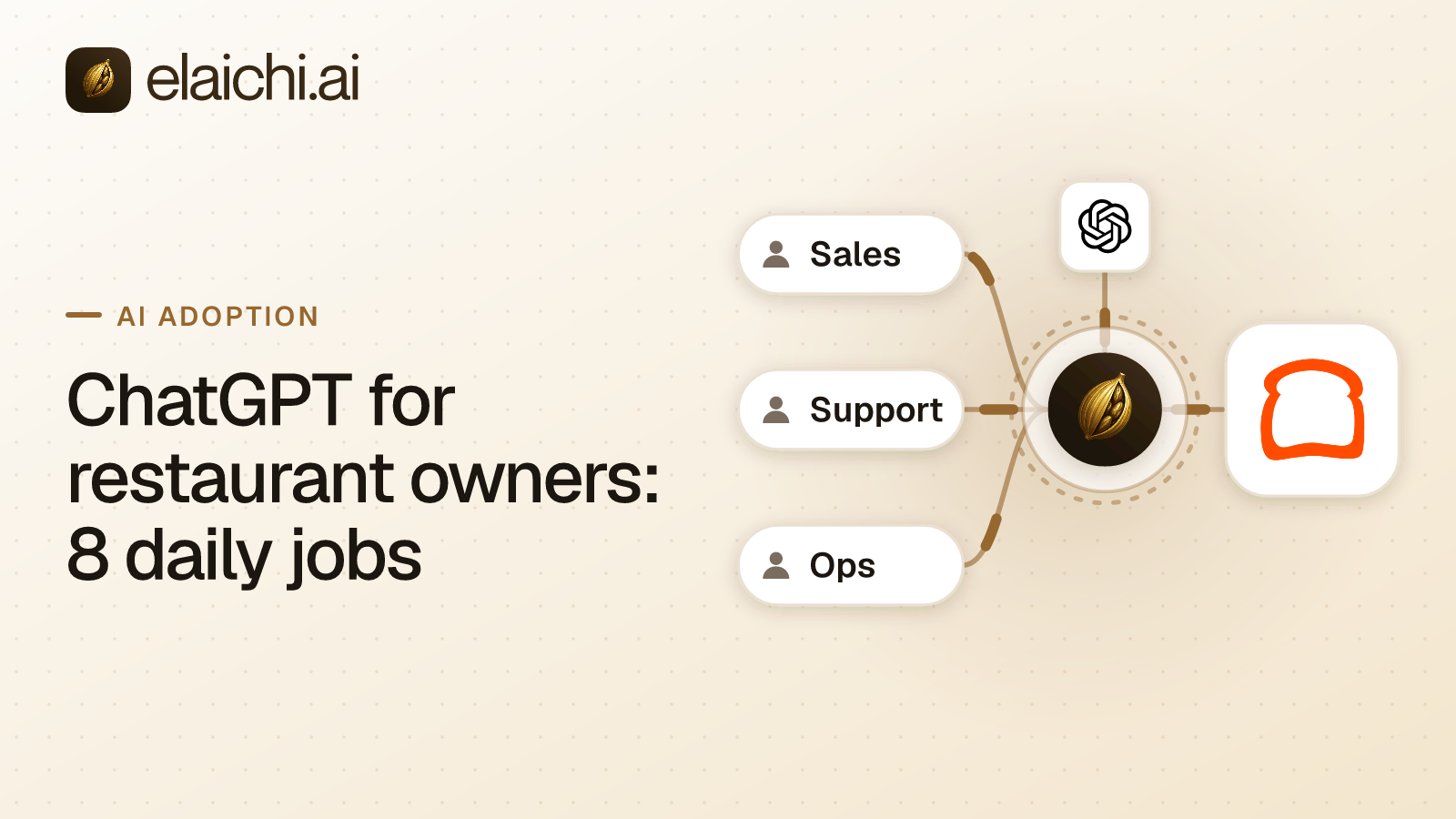
ChatGPT for restaurant owners can do most of that legwork once it can reach your apps. Claude works the same way. Elaichi is the link between the chat and your apps. You type the question in your own words, and the AI reads the answer from live data.
Which eight jobs does ChatGPT for restaurant owners cover?
Owners and managers can hand over eight jobs, and each one uses a real tool in the app. Here is what you might type for each.
- Sales. "What did we sell last night at each restaurant?" The AI reads the sales report for each location. Toast in Claude shows more.
- Voids and discounts. "Which orders were voided at Downtown last night?" It reads the day's orders and lists the voids.
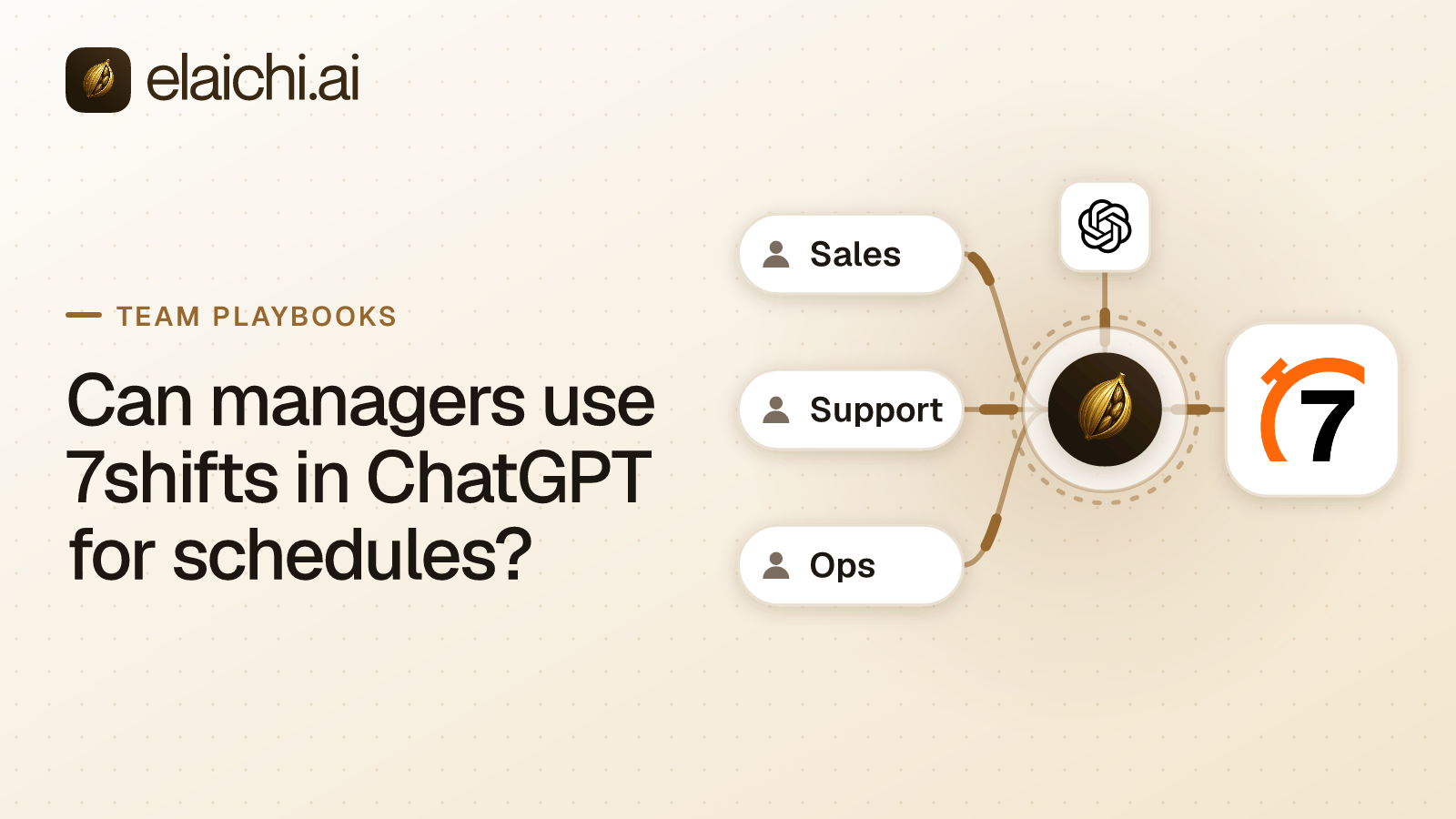
- Late clock-ins. "Who clocked in late at Elm Street this week?" It reads 7shifts punches. 7shifts in ChatGPT covers this.
- Open shifts. "Which Saturday shifts have nobody on them?" It reads the shifts and lists the empty ones.
- Food cost. "What did chicken cost us this month versus last?" It reads price history in MarginEdge. Ask MarginEdge about food cost walks through it.
- Private events. "Which private events are booked next week?" It reads events in Tripleseat.
- Catering leads. "Turn this catering email into an event lead." It reads the Gmail message and creates the lead in Tripleseat. Tripleseat in ChatGPT has the full list.
- A note to the owner. "Draft a short email about last night's voids and discounts." It saves a draft in Gmail.
The AI adds up numbers itself. Check a total before you act on it.
Can ChatGPT run my restaurant reports on its own?
Yes. Turn one prompt into a workflow, which is a task that starts by itself. For example: every Monday at 7 am, read last week's sales and labor for each restaurant and save a Gmail draft to the owner. In chat, the AI acts right away. In a workflow, you can add an approve step, so a named person must approve before anything is sent or changed. The AI never approves its own work. Run it once as a test first. A test run reads real data but changes nothing. Build it by asking Claude or ChatGPT in plain words, or in the Elaichi app. Workflows come with the Black plan. Every workspace starts on a 14-day Black trial with workflows included, so you can try this free.
What will the AI not do for a restaurant?
The AI cannot reach apps outside the catalog, and it cannot read your mind about who may change what. Some tools can change a live restaurant, and a team lead on Gold has to switch them off. Elaichi does not ask before each call.
- Toast can void an order and change a wage. Both tools exist. Restrict them for managers.
- 7shifts can delete a shift and change pay. It can also add a shift. Shift and punch records show pay rates, so decide who may see pay first.
- Tripleseat can delete a lead, an event or an account. Restrict those for the sales role.
- MarginEdge only reads. MarginEdge says its Public API only supports data retrieval, and its own AI link is read-only (MarginEdge help, checked November 2026).
- Gmail writes drafts, and it can send. A team lead on Gold should restrict send if you want drafts only.
- DoorDash, Uber Eats, Grubhub, Resy and Yelp are not in the catalog. That is true as of November 23, 2026.
The Claude or ChatGPT app may show its own approval prompt before a tool runs. That prompt belongs to the AI app, not to Elaichi.
How does a team lead set what each manager may change?
A team lead sets it with a restriction, which is a rule that turns off named tools for a role. Restrictions come with Gold. Personal, the free plan, has none. On Personal the AI can do whatever your own app logins allow.
Say the manager role may read sales and shifts. The lead restricts the tools that void orders, change pay and delete shifts. A restricted tool cannot be called, and search still shows it, flagged as restricted. A new rule takes effect within about two minutes. A rule that names tools leaves every unnamed tool open, so name them all. Elaichi also keeps one entry for each connected-tool call that reaches execution (a call refused earlier writes none). See making ChatGPT read-only in company tools.
One more limit applies. A hidden instruction inside a customer email or an order note can try to steer the AI, and Elaichi does not screen for it. Read what the AI plans to do before you let it act.
What does it cost a restaurant?
One person can start free. A group that wants shared rules moves to Gold, which lists at $15 per user per month in USD, or $10 per user per month billed annually. See pricing for the current figures.
Elaichi's free Personal plan fits one person, three apps and ten connections. Toast needs one connection per restaurant, so a three-restaurant group uses three connections for Toast alone. Personal also caps use at 1,000 tool calls a month. You also need a ChatGPT or Claude plan of your own.
OpenAI says ChatGPT Business admins and owners add a custom server for the workspace, and Pro can connect one with read and fetch permissions only, so saving drafts or logging work needs Business, Enterprise or Claude (OpenAI help, checked November 2026). Anthropic says Claude Free allows one custom connector, and Team plans let owners add it (Anthropic help, checked November 2026).
If you only work in Toast, Toast's own tools may be enough. This pays off when one question crosses sales, labor and food cost.
Is food cost the question that pays first?
Often it is, because food is the biggest bill after labor. The National Restaurant Association reports a median food cost near 32 percent of sales in 2024 for both full-service and limited-service restaurants, from more than 900 operators (National Restaurant Association, checked November 2026). A few points of drift is real money.
A good first question is the one that crosses two apps. "Did last week's sales hold while chicken got more expensive?" needs Toast and MarginEdge. The AI reads both and you read the answer.
How does a restaurant get started?
Start with two apps and one question.
- Sign up for Elaichi and add the app you check first, such as Toast, plus Gmail. Each app asks for a key or a sign-in. An admin makes the key inside that app.
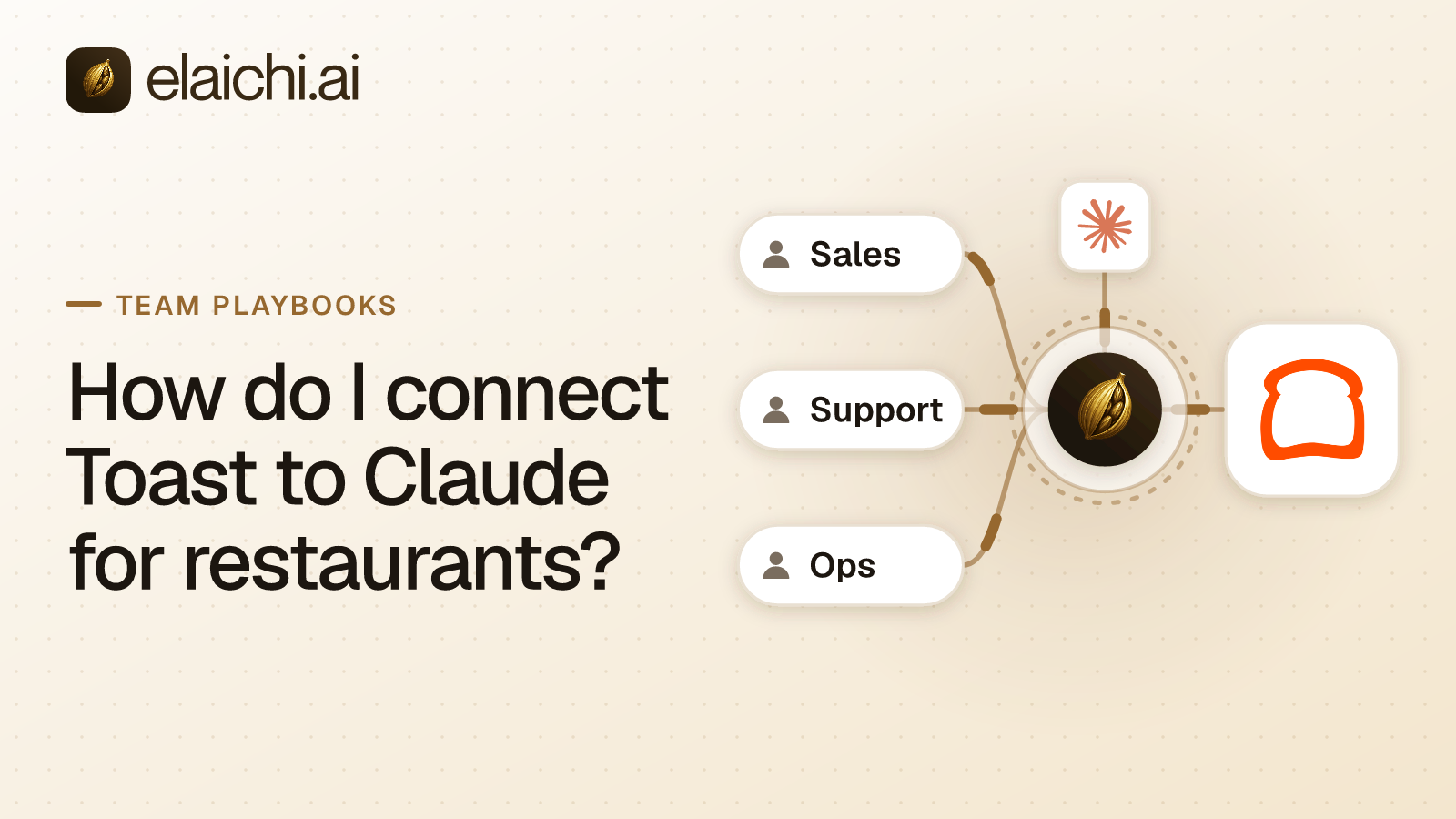
- In Claude, add the address
https://api.elaichi.ai/mcpas a custom connector. In ChatGPT Business, an admin adds it under Plugins. - Open a chat and ask what sold last night.
Browse the 1000+ connectors for the rest of your stack, or open the Toast page, the 7shifts page and the MarginEdge page.
 Add one link to your AI app
 ChatGPT
 Claude
 Cursor
 Microsoft Copilot