

Comparisons
How the MCP gateways differ, who each one is built for, and the cases where the honest answer is that you do not need one.
MCP audit log comparison: what each shape records
An MCP audit log comparison across four shapes: what each one records about intent, the account reached, arguments, and whether AI actorship is a field.
 Uday Gajavalli
Managed MCP connectors vs open-source MCP servers
Managed MCP connectors vs open-source MCP servers is a question about operating cost: sign-in, credentials, per-person access, the audit trail and offboarding.
 Raajshekhar Rajan
Copilot Studio vs MCP gateway for company apps
Copilot Studio vs MCP gateway: where each one puts the rules about which company app an AI client may reach, and who gets to write them.
 Roopendra Talekar
Docker MCP Gateway vs a managed MCP platform
Docker MCP Gateway vs a managed MCP platform: Docker runs MCP servers in containers you operate. Elaichi serves connectors behind one sign-in URL.
Roopendra Talekar
Kong vs Cloudflare MCP gateway, or managed connectors?
Kong vs Cloudflare MCP gateway: both govern MCP servers you build or bring. A managed connector platform ships the SaaS connectors already written.
 Nachi Raman
Elaichi vs Composio: who writes your connectors?
Elaichi vs Composio: Elaichi writes most of its connectors and serves them on one company-wide MCP endpoint. Composio covers more apps, one endpoint per team.
Roopendra Talekar
Claude and ChatGPT connectors vs one MCP endpoint
Claude and ChatGPT connectors fit one client and a few apps. Once a second client repeats the setup, one governed MCP endpoint costs less to run.
Roopendra Talekar
Lunar MCPX alternative: count your servers first
With no MCP servers to front, the Lunar MCPX alternative is a hosted server like Elaichi. With several, a gateway like MCPX still fits.
Raajshekhar Rajan
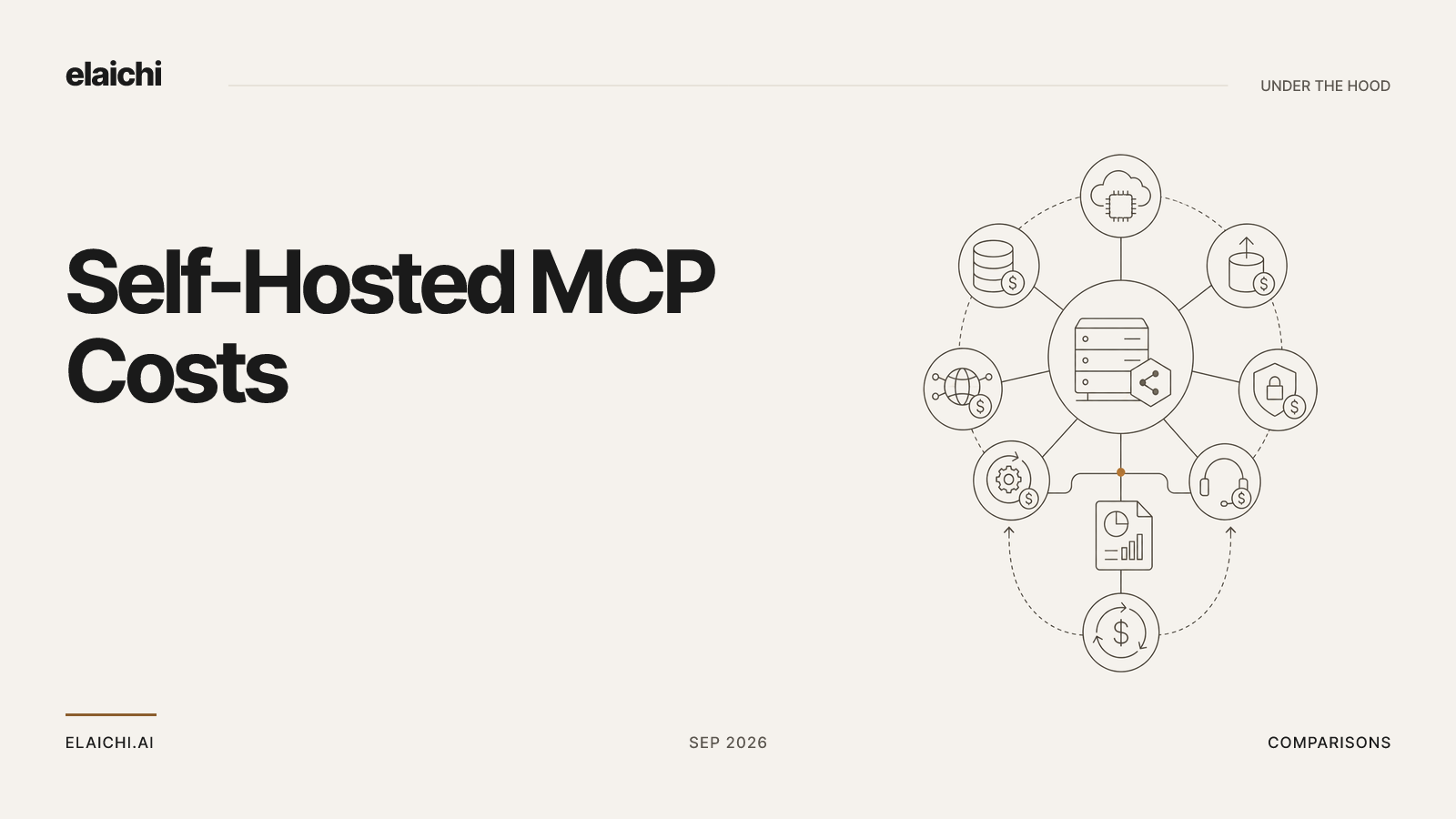
Running your own MCP servers: the real cost
Running your own MCP servers wins for one internal tool. Managed wins once credentials, token refresh, per-user sign-in and audit multiply.
Roopendra Talekar
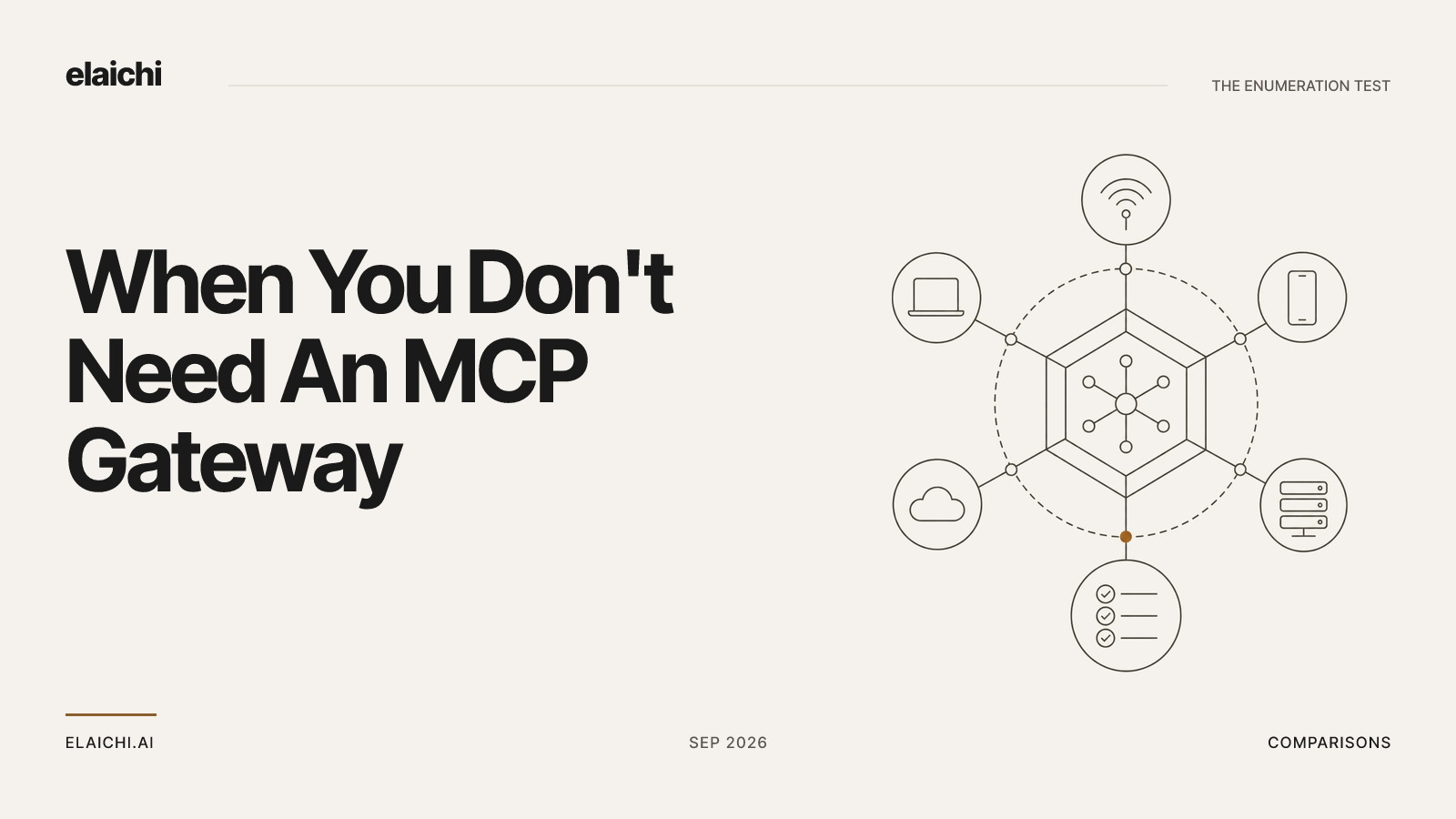
When you don't need an MCP gateway yet
Per-user connectors plus SSO are enough while you can name everyone connected. That is when you don't need an MCP gateway, and four signals end it.
Roopendra Talekar
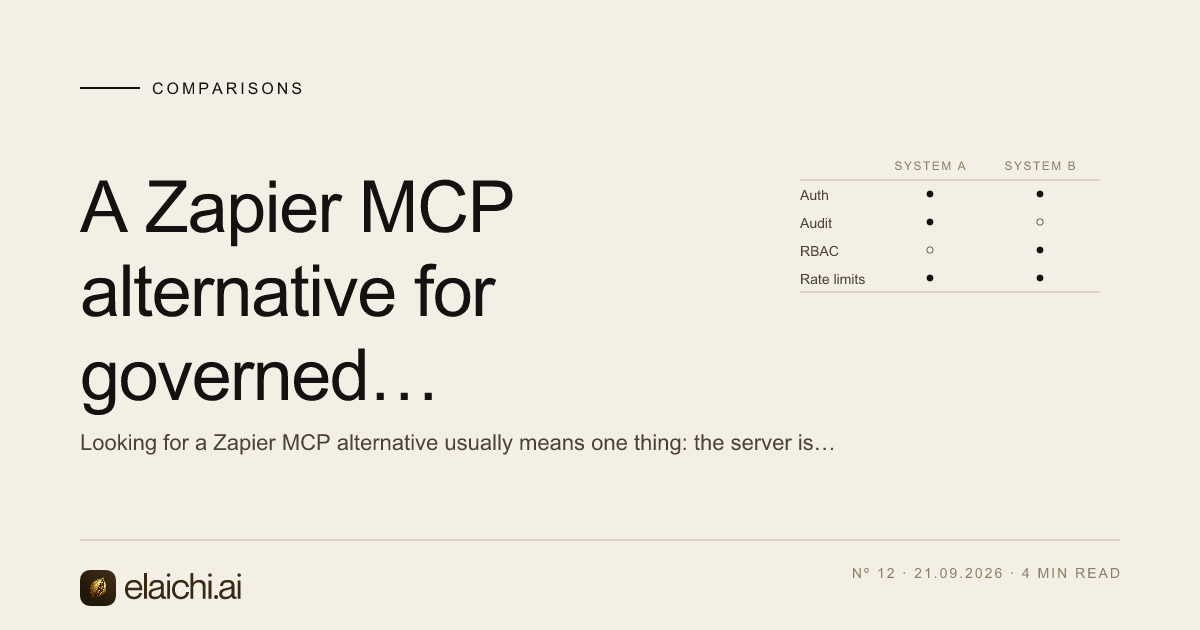
Zapier MCP alternative for a whole company
Elaichi is a Zapier MCP alternative: one organization endpoint with role restrictions and an audit log. What each costs, and when Zapier fits.
Roopendra Talekar
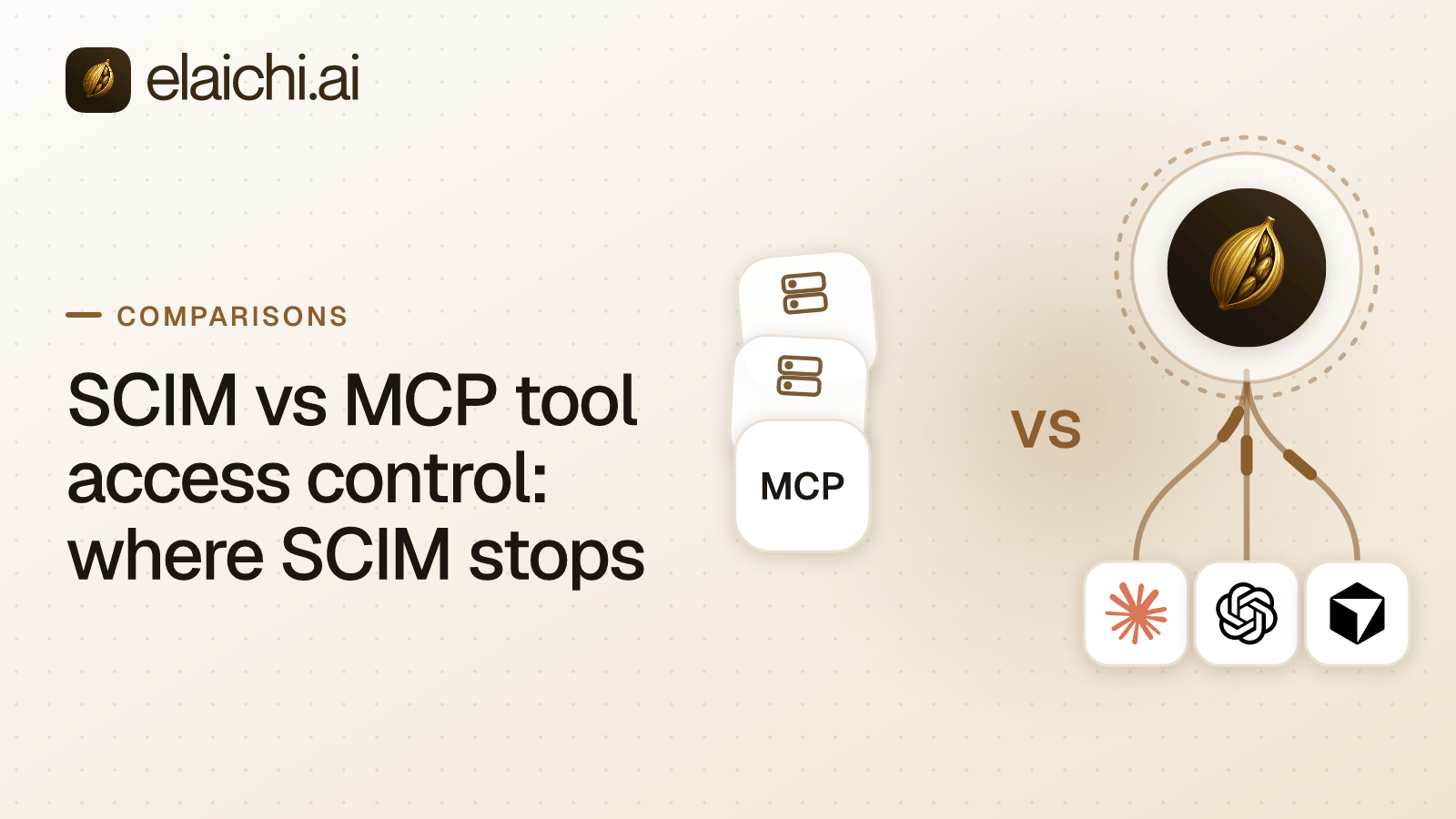
SCIM and AI agents: where provisioning stops
SCIM and AI agents meet at the user account: SCIM creates, updates and deactivates it, but it never decides which tools an agent may call.
Uday Gajavalli
MCP endpoint per team, per person or per company?
One endpoint per company usually beats an MCP endpoint per team or a server per person: each AI client needs one entry, and a leaver is one action.
Roopendra Talekar
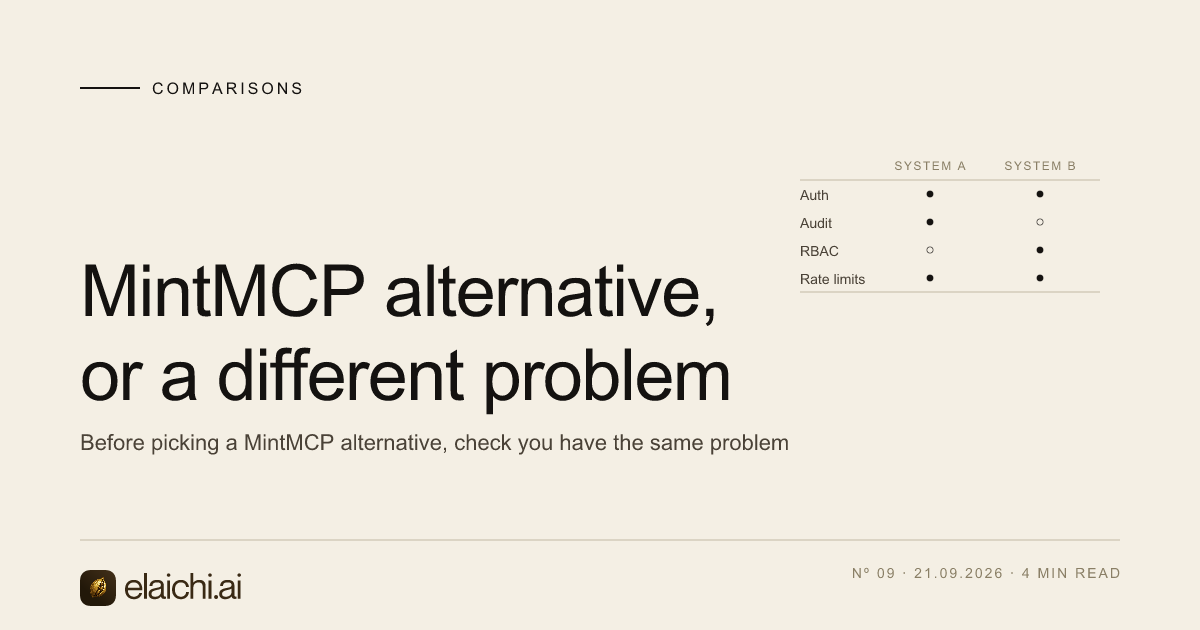
Choosing a MintMCP alternative for employee AI access
Choosing a MintMCP alternative for employee AI access comes down to two things: one address every AI client signs into, and one governed connector catalog.
Nachi Raman
Best MCP gateways for company-wide AI access
The best MCP gateways come in four shapes: a hosted catalog, a gateway you run, a per-member server or a control plane. Pick the shape, then the vendor.
Uday Gajavalli
Elaichi vs Merge Agent Handler: three forks
Elaichi vs Merge Agent Handler comes down to three forks: one address or many, a grant or a stored secret, and who authors the connectors.
Roopendra Talekar
An API gateway for MCP, or an MCP-native server?
An API gateway for MCP fits when the tools are your own APIs, already behind it. For SaaS accounts your staff sign in to, an MCP-native server fits better.
Uday Gajavalli
MCP gateway pricing: per seat vs per call
MCP gateway pricing is metered per call, per task or per seat. Per call is cheaper at low volume; per seat is the bill a company can forecast.
Raajshekhar Rajan
Put AI to work in your own apps
14 days of Black, no credit card. Start with one app and one team.
When the trial ends, nothing is deleted. You move to the free Personal plan, and connections, roles and the audit log stay where they are.
 Add one link to your AI app
The same link for everyone on your team.
https://api.elaichi.ai/mcp
 ChatGPT
 Claude
 Cursor
 Microsoft Copilot